
Marine and Blue Economy
NPERA Begins Six-Month Transition, Targets Lower Port Costs, Greater Efficiency


By Stella Okocha
The newly established Nigerian Ports Economic Regulatory Agency (NPERA) has commenced a six-month transition from the Nigerian Shippers’ Council (NSC), setting 30, 60 and 90-day targets to overhaul economic regulation, reduce the cost of doing business and improve the competitiveness of Nigerian ports.
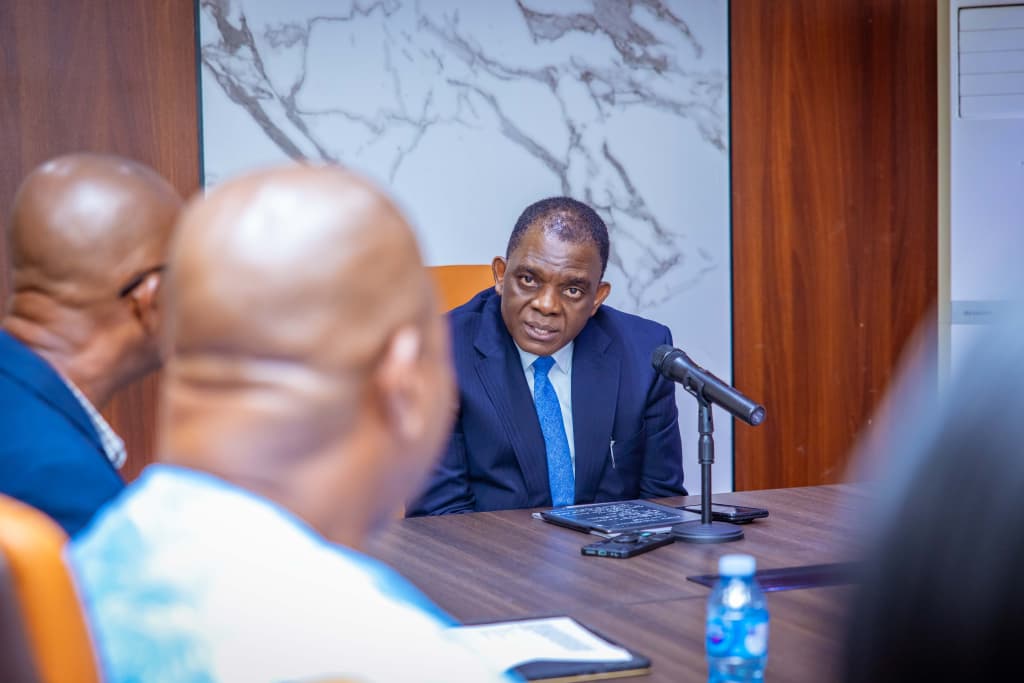 The Director-General and Chief Executive Officer of NPERA, Dr Akutah Pius Ukeyima, disclosed this when a delegation of the Congress of Nigerian Maritime Media Practitioners (CONMMEP) visited the agency to seek clarification on its new mandate, transition programme and reform priorities.
 Ukeyima said the Nigerian Port Economy Regulatory Agency Act 2026 had fundamentally changed the architecture of economic regulation in the port sector by repealing the Nigerian Shippers’ Council Act, Cap N133 of 2004, and establishing NPERA with a broader regulatory mandate.
He stressed that the development represented more than a change in institutional identity, describing it as a restructuring of the system for regulating Nigeria’s port economy.

Some Senior Management Statffs of Nigerian Ports Economic Regulatory Agency (NPERA) at the meeting
According to him, the former Shippers’ Council was principally established to protect the interests of shippers, including negotiating freight rates and port charges and promoting the development of shippers’ associations.
NPERA, he said, now has a wider responsibility encompassing the broader port economy, including economic regulation, efficiency, competition and cost management.
Ukeyima explained that the reform was rooted in developments following the concession of Nigerian ports in 2006, when concerns arose over the overlapping roles of government agencies involved in both regulation and service delivery.
“Those developments eventually resulted in the designation of the Nigerian Shippers’ Council as the interim economic regulator of the ports in 2014, pending legislation establishing the function on a permanent statutory basis”
“With the passage of the NPERA Act, that legal framework is now in place,” Ukeyima said.
He disclosed that the agency had mapped out milestones for the first 30, 60 and 90 days, as well as 100 days, one year and beyond.
The DG said the immediate objective was to complete the institutional transition within six months while simultaneously developing regulations required to operationalise the new law.
He assured stakeholders that they would be carried along throughout the process, with major policy directions guided by the Minister of Marine and Blue Economy.
As part of the transition, Ukeyima disclosed that the Minister of Marine and Blue Economy had directed the Nigerian Shippers’ Council to hand over the inland dry ports it had been promoting across the country to the Nigerian Ports Authority (NPA).
He said discussions were already ongoing with the NPA Managing Director to facilitate the implementation of the directive.
The NPERA boss also said Section 51 of the new Act provides for the preservation of existing contracts and unresolved matters, as well as protection of the offices and employment of existing appointees and workers during the transition.
As port efficiency and the high cost of doing business emerged as major priorities for the new regulator, Ukeyima identified the presence of multiple government agencies in the port environment and excessive human interaction in cargo-processing procedures as key areas requiring reform.
He said the continued reliance on processes involving multiple physical interactions was out of step with the global movement towards digitalisation and automation.
According to him, operational inefficiencies increase the cost of doing business and weaken the ability of Nigerian ports to compete with ports in neighbouring countries.
He also identified the high cost of port infrastructure and services as another factor affecting Nigeria’s competitiveness in international trade.
Effective dispute resolution, he added, would be critical to improving the predictability and cost of doing business in the maritime sector.
Ukeyima said the impact of the new regulatory framework would ultimately be assessed by the extent to which businesses and consumers experience improvements in efficiency, reduced costs and greater competitiveness.
The new law has also introduced stronger penalties for regulatory violations, with NPERA seeking to improve compliance and strengthen deterrence.
Ukeyima said some penalties under the repealed legislation were as low as N300 and N500, which he considered inadequate for a modern maritime economy.
Under the new framework, he disclosed, penalties for certain infractions could range from N500,000 to N20 million.
He stressed that the objective of the increased penalties was primarily deterrence against activities capable of undermining trade facilitation and the efficient operation of the port economy.
Ukeyima further disclosed that the Federal Government was intensifying efforts to attract foreign direct investment and other sources of funding for the modernisation of Nigeria’s port infrastructure.
He said some modernisation projects had reached advanced stages and were before the Federal Executive Council, while funds had also been approved to support port development.
The investments, he said, formed part of broader government efforts to strengthen institutions, reform the maritime sector and position the blue economy as a driver of economic diversification.
He added that improvements in port efficiency would have implications beyond maritime businesses, as the cost and speed of moving goods through Nigerian ports ultimately affect consumers and the wider economy.
 Earlier, CONMMEP President, Udo Onyeka, called for sustained engagement between the maritime media and NPERA to improve public understanding of the agency’s mandate and reforms.
Onyeka said the efficiency of Nigerian ports, logistics costs, ease of doing business, competitiveness of Nigerian enterprises and growth of non-oil exports were closely linked to the effectiveness of maritime regulatory institutions.
 He said journalists had a responsibility to keep the public accurately informed while providing regulators and industry stakeholders with opportunities to explain their policies, achievements and challenges.
He identified shipping and logistics costs, port congestion, tariffs and charges, demurrage, shipper protection, port digitalisation, the National Single Window, non-oil exports, regional maritime connectivity, maritime security and the blue economy as areas requiring sustained media scrutiny.
The CONMMEP president called for regular briefings, access to credible data, technical explanations of policies and greater interaction between officials and journalists.

The Director-General/Chief Executive Officer of the Nigerian Port Economy Regulatory Agency (NPERA), Dr. Akutah Pius Ukeyima with the President of the Congress of Nigerian Maritime Media Practitioners (CONMMEP), Udo Onyeka, during the Congress’s engagement with the agency.
He, however, stressed that the relationship between the media and NPERA must be anchored on access, transparency, professionalism and mutual respect, rather than turning journalists into a public relations arm of the agency.
Onyeka said CONMMEP expected the engagement to develop into a sustained relationship in which journalists would continue to scrutinise developments in the port economy while giving regulators and other stakeholders opportunities to explain their policies and actions.
With its six-month transition now underway, NPERA faces the task of building the regulatory machinery envisaged by the 2026 Act while addressing some of the longstanding concerns around port costs, efficiency, digitalisation and competitiveness.






Integrate Security Awareness Into School Curriculum, Tantita Executive Urges FG

LASWA Calls For Homegrown Multimodal Transport Model

Tantita Security Calls For Overhaul Of Nigeria’s Maritime Security System

Dredgers Association Disowns Report Alleging Extortion Against Lagos Commissioner Alebiosu

Customs FOU Zone A Intercepts Five Live Pangolins In Ogun, Hands Over To Wildlife Centre

Blue Line: LAMATA To Add Alakija, FESTAC, Trade Fair Stations By February 2027

Lagos Blue Economy: Govt Engages Riverine Women Leaders On Inclusion, Sustainable Development

NFVCB Moves To Take Nollywood To China As Board Meets China Film Administration

NIHOTOUR Honours Tinubu With Highest Tourism Award As President Backs Sector Reforms

Oyetola Inaugurates NIMBEX Committee To Drive Maritime Investment

Customs Operation Whirlwind Seizes 38,700 Litres Of Smuggled Fuel In Adamawa, Worth N63.1m

Operation Sea Guardian: NIMASA Cracks Down On Cabotage Violators In Lagos Waters

NCS FOU Zone C Seizes 3,310 Jerrycans of Smuggled Vegetable Oil Worth ₦403.5m

Compt Joe Anani Records ₦178 billionin Revenue; Handover Leadership to DC MIiko

APAPA PORT COMMAND INTERCEPTS ₦26.5B CANNABIS INDICA CONCEALED WITH IMPORTED VEHICLES

Revenue Boost: Apapa Customs Record ₦28 Billion in 24 Hours; Strengthens Government’s Revenue.

NIMASA Strengthens Partnership on Seafarer’s Warfare with Mission to Seafarers (MtS)

Nigeria Customs Raises Breast Cancer Awareness in Abuja, Secures ₦50m Pledge

NIMASA Deepen Collaboration with NSIB to Promote Maritime Safety, Security

NRC Unveils Plans to Electrify Major Rail Corridors From Lagos, Warri Within 5 Years

NIMASA to sponsor 10 staff annually for Master’s degrees under renewed WMU partnership

DC ADEWOLE VISITS ASEYIN OF ISEYIN LAND AND SOUN OF OGBOMOSHO, SEEKS TRADITIONAL SUPPORT AGAINST SMUGGLING

NIMASA DG GETS AWARD OF RECOGNITION ON IMPACTFUL MENTORSHIP FROM ALMA MATER
