
Maritime
CVFF Disbursement Stalled By Flawed Guidelines, Omatseye Tells FG To Scrap Rules

By Stella Okocha
Former Director-General of Nigerian Maritime Administration and Safety Agency, NIMASA, Temisan Omatseye, has called for scrapping of existing guidelines for disbursement of $700 million Cabotage Vessel Financing Fund, CVFF, describing framework as fundamentally flawed.
Omatseye said guidelines place unreasonable burden on participating banks by requiring them to bear 100 per cent credit risk despite contributing only 35 per cent of financing and having limited control over selection of beneficiaries.
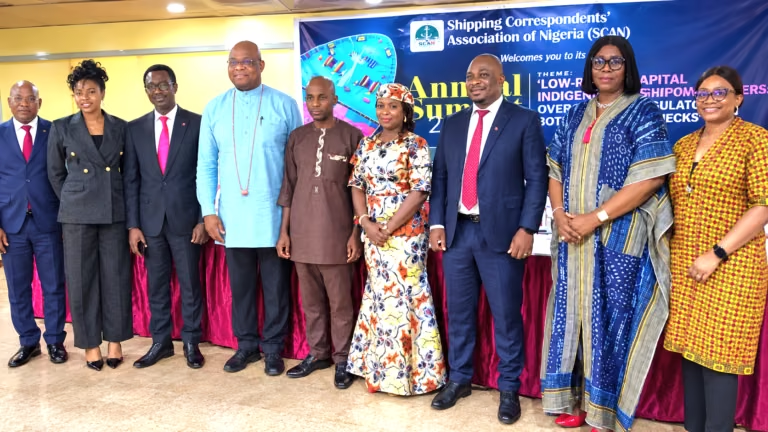
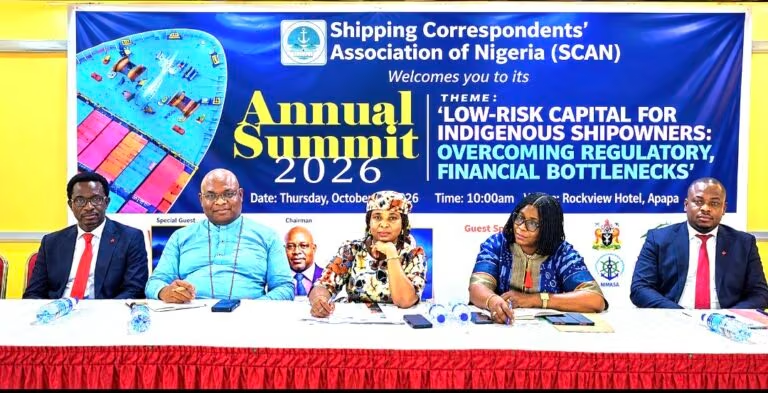 He said this at the 2026 Annual Summit of Shipping Correspondents Association of Nigeria, SCAN, held at Rockview Hotel, Apapa, Lagos, themed “Low-Risk Capital for Indigenous Shipowners: Overcoming Regulatory and Financial Bottlenecks.”
The CVFF, established under Coastal and Inland Shipping (Cabotage) Act 2003 to support Nigerian shipowners acquire vessels, has remained undisbursed for over two decades, leaving indigenous operators struggling against foreign competitors with cheaper financing.
NIMASA disclosed that out of 92 applications for the fund, only 20 were forwarded to Primary Lending Institutions, PLIs, while just one reached final approval stage, despite Minister of Marine and Blue Economy, Adegboyega Oyetola, directing commencement of disbursement.
Explaining origin of guidelines, Omatseye said they were introduced in 2003 to protect fund after losses recorded under former Ship Acquisition Fund of defunct National Maritime Authority, NMA, where money was given out without refund.
Under structure, CVFF provides 50 per cent, bank provides 35 per cent, and shipowner brings 15 per cent equity, but banks bear full default risk.
“If I knew what I know now, I would do things differently. The Guidelines are functionally bad,” Omatseye said.
“Let me put it in a different way, I’m lending Mrs Precious 100 million dollars. You will take 50 million from my CVFF and give it to her. You, the bank, will bring 35%. And then borrower will bring 15%. But, there’s a caveat. If Mrs Precious does not pay, you, the bank, take 100% of the risk. Meanwhile I will be telling you who to give that money to.”
He argued that arrangement conflicts with Banks and Other Financial Institutions Act, BOFIA, 2020, which gives banks power of risk assessment, noting banks cannot be told who to lend to while bearing full risk.
“So, the banks told me that this is the problem we are having. You cannot allow me to take the risk assessments. And then, you now want me to take 100% of the credit risk if the borrower does not pay back,” he said.
He added banks would rather keep money in fixed deposits than lend under such conditions.
Beyond CVFF, Omatseye called for private-sector-driven financing model, citing enormous opportunities in crude lifting, Dangote Refinery’s 650,000 barrels per day requirement, LNG shipments and solid minerals, but said need for bankable data on cargo availability from IOCs and Nigerian Content Development and Monitoring Board.
He also questioned competitiveness of Nigerian banks, noting LNG tanker costs about $250 million while local lending rate is 25 per cent compared to 2 per cent abroad, with foreign firms accessing 85 per cent financing.
In keynote, Senior Advocate of Nigeria, Dr. Olisa Agbakoba, said Nigeria does not have to rely on government funds for every vessel but develop system to attract private capital through cargo commitments, enforceable contracts and regulatory certainty. He proposed six priority actions including cargo-backed financing and improved cargo access.
Minister Oyetola, represented by Director of Press, Anastasia Ogbonna, reaffirmed Federal Government commitment to disburse CVFF, disclosing launch of dedicated portal in January 2026 and increase of PLIs from five to 12, directing NIMASA to work closely with banks to accelerate assessment.
He said fund must be administered transparently as revolving facility.
UBA’s Regional Manager 2, Apapa, Nelson Edoye, reaffirmed bank’s commitment to innovative, de-risked financing structures.
SCAN President, Moses Ebosele, said indigenous shipping remains central to economic growth but faces high borrowing costs, multiple charges, policy inconsistency, inadequate repair infrastructure and insecurity, urging accessible long-term funding.
“Indigenous shipping must be recognised as a strategic national economic asset rather than merely a private commercial undertaking,” Ebosele said.






Dantsoho: NPA Operations Now 90% Automated, Says Agency To Tour All Inland Dry Ports

CVFF Disbursement Stalled By Flawed Guidelines, Omatseye Tells FG To Scrap Rules

NPERA To Institute Annual Honesty Prize For MAN Oron Cadets From 2027

Trade Facilitation: US Chamber, American Businesses Hail Customs Reforms, PEBEC Top Ranking

Babalakin Inspects MMA2 Ahead of Regional Operations Commencement

Germany-Nigeria Film Week 2026 Closes With Awards For Schlöndorff, Musawa, Gani Adams, Others

MMAC Customs Command Gets New Controller As Otunla Bows Out After N175.6bn Revenue

Blue Lagos, New Generation Directorate Host 250 Riverine Youth Leaders In Lagos

Nigeria Showcases Maritime Security Strength At AFRIDEX 2026

Customs Vows Not To Return To FATF Grey List As Nigeria Prepares For Next Evaluation

Niger/Kogi Customs Command Holds Diabetes Awareness, Fire Safety Lecture For Officers

Integrate Security Awareness Into School Curriculum, Tantita Executive Urges FG

NCS FOU Zone C Seizes 3,310 Jerrycans of Smuggled Vegetable Oil Worth ₦403.5m

Compt Joe Anani Records ₦178 billionin Revenue; Handover Leadership to DC MIiko

APAPA PORT COMMAND INTERCEPTS ₦26.5B CANNABIS INDICA CONCEALED WITH IMPORTED VEHICLES

Nigeria Customs Raises Breast Cancer Awareness in Abuja, Secures ₦50m Pledge

Revenue Boost: Apapa Customs Record ₦28 Billion in 24 Hours; Strengthens Government’s Revenue.

NIMASA Strengthens Partnership on Seafarer’s Warfare with Mission to Seafarers (MtS)

NIMASA Deepen Collaboration with NSIB to Promote Maritime Safety, Security

NRC Unveils Plans to Electrify Major Rail Corridors From Lagos, Warri Within 5 Years

NIMASA to sponsor 10 staff annually for Master’s degrees under renewed WMU partnership

DC ADEWOLE VISITS ASEYIN OF ISEYIN LAND AND SOUN OF OGBOMOSHO, SEEKS TRADITIONAL SUPPORT AGAINST SMUGGLING

NIMASA DG GETS AWARD OF RECOGNITION ON IMPACTFUL MENTORSHIP FROM ALMA MATER
